

“Who does the best smile makeover in Dublin?” is a question we get asked a lot, and we understand why people ask it. It is a big decision and a real investment, and everyone wants a shortcut to the right answer.
Here is the honest answer: nobody can hand you a ranked list, and you should be sceptical of anyone who tries. What you can do — and what almost nobody explains — is learn to judge the result itself. There are specific, checkable things that separate a smile makeover that still looks natural in fifteen years from one that looks like dental work from across a room. Better still, you can see most of them before a single tooth is touched. We really love this stuff, so let us walk you through exactly what to look at.
What actually makes a smile makeover the best one for you?
There is no single best smile makeover in Dublin — only the one designed for your face. Costs run from around €2,700 for composite bonding to €12,000 for a full porcelain veneer makeover.
A smile makeover is not a product you buy off a shelf. It is a plan, and the same plan applied to two different faces gives two very different results. The width of your smile, how much tooth shows when you talk, where your lip sits when you laugh, the shape of your face — all of it changes what “right” looks like.
Which is why the most useful question is not “who is the best?” but “can this person show me what they are planning, and can they justify every decision in it?” A dentist who can talk you through why your central incisors should be a particular length, and what that does to the rest of the smile, is telling you something far more meaningful than any award badge.
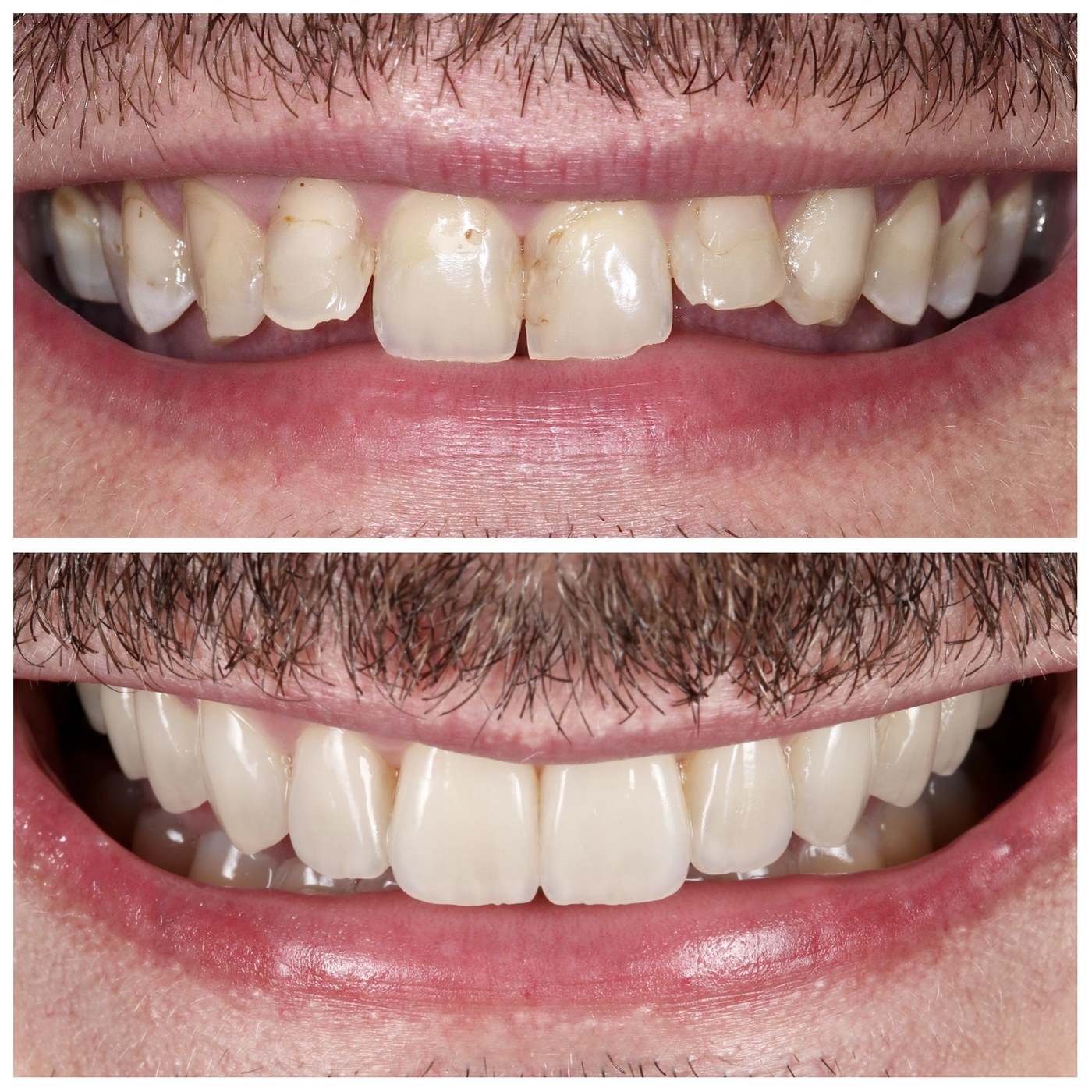
Can you actually see the result before you commit?
Yes. A digital smile design preview costs €350 in Dublin and a physical trial smile lets you wear the proposed result in your own mouth before any irreversible treatment begins.
This is the single most important thing in this article, so we will be blunt about it: you should not commit to a smile makeover you have not seen. Not a stock photo of someone else. Yours.
The process runs in two stages. First we photograph and measure your smile and design it digitally — that is Digital Smile Design, and at Docklands it is a €350 planning fee. Then, in most cases, we can convert that design into a mock-up placed directly over your teeth, so you can look in the mirror, go home, show your partner, eat a sandwich and come back and tell us what you want changed.
Look, we know a trial smile adds a step. But we would far rather you change your mind at the mock-up stage than after the porcelain is bonded on. It is the cheapest possible time to say “actually, that is too long”.
What does a well-designed smile makeover look like up close?
Five things give it away: tooth proportions of roughly 75-80% width to height, a midline matching the face, an incisal edge following the lower lip, even gum heights, and graded translucency.
You do not need a dental degree to check these. Get a good, well-lit photo of the dentist’s actual finished cases — not stock images, not a heavily filtered reel — and look for:
- Proportion. Front teeth that are roughly three-quarters as wide as they are tall look right to the human eye. Squarer than that reads as blocky; narrower reads as horsey.
- The midline. The join between the two front teeth should line up with the centre of the face, not the centre of the remaining teeth.
- The smile line. The edges of the upper teeth should follow the curve of the lower lip. A flat, straight edge across all six front teeth is the most common giveaway of a rushed design.
- Gum symmetry. The gum heights on matching pairs of teeth should sit level. Uneven gums draw the eye far more than most people expect.
- Translucency. Real enamel is more see-through at the biting edge than at the gum. Teeth that are one flat shade from top to bottom look opaque and artificial.

These are the things our ceramicist, Vladimir Savchuk, spends his time on when he hand-builds feldspathic veneers — and they are the reason we still work in that material rather than something faster to produce.
What are the warning signs of a result that will not age well?
Uniform brightness, identical tooth shapes, bulky margins and inflamed gums are the visible warnings — heavy tooth preparation is the invisible one, since veneers bonded to enamel survive at 91% at 15 years.
The research backs the last point up firmly. A 2021 systematic review in the European Journal of Dentistry pooled the long-term veneer data and found survival of 96% at ten years and 91% at both fifteen and twenty years for veneers bonded to enamel, with ceramic fracture accounting for around 45% of the failures that did happen. The teeth in the best-performing studies had kept their enamel.
That is the practical argument against aggressive preparation. Once a tooth has been drilled down past its enamel, the bond has less to hold onto and the tooth is committed to being crowned for the rest of its life. We work to around 0.3-0.5mm of preparation on veneer cases, and on plenty of cases we prepare nothing at all. If someone proposes taking a lot of tooth away to make a cosmetic result easier, ask why, and ask what the alternative would look like.
The other quiet warning sign is red, puffy gums in the “after” photos. Healthy gums after a makeover should look like healthy gums — pink and tight to the tooth. Irritated tissue usually means the margins of the restorations are sitting where they should not be.
Does it matter who actually does the work?
A porcelain smile makeover in Dublin involves at least two pairs of hands — the dentist who designs and bonds it, and the ceramicist who hand-builds the porcelain.
Most people assume the dentist makes the veneers. They do not. The design, preparation and bonding are ours; the actual porcelain is hand-built by a ceramicist, layer by layer. If a practice cannot tell you who builds their porcelain, that is worth noticing.
And where a case involves gum work, orthodontics or implants first, it should involve the relevant specialist. We work with the specialists at the Institute of Specialist and Cosmetic Dentistry on exactly those cases — you can see how that plays out in practice in our full smile makeover case story, where the sequencing mattered more than any individual treatment.
There is a wider version of this question — what separates a genuinely good cosmetic dentist from a well-marketed one — which we have written about separately in what makes a cosmetic dentist worth it.
What should a smile makeover cost in Dublin, and what does the price buy?
A composite bonding smile makeover in Dublin costs €2,700-€4,500 for six to ten teeth, a porcelain veneer makeover €7,200-€12,000 at €1,200 per hand-made feldspathic veneer, and full-mouth reconstruction €15,000-€30,000+.
Those are our real numbers, and every individual fee behind them is published on our price list — a composite veneer is €450 per tooth, a hand-made feldspathic veneer €1,200, a hand-layered anterior crown €1,200, Digital Smile Design €350.
What the higher figure buys is not a better brand. It is laboratory time, a hand-built material, and the planning that goes in front of it. What it should never buy is pressure. We do not run discounts or limited-time offers on cosmetic work, because a price that expires on Friday is a reason to decide quickly, and deciding quickly is exactly what you should not do here. If you want the full tier-by-tier breakdown, we have written it up in smile makeover cost in Dublin.
One honest caveat on the number of teeth: most makeovers involve six to ten upper teeth rather than a full set, and the right count depends on how wide your smile is. That is covered in how many veneers you actually need.
How long should the result last?
Porcelain veneers bonded to enamel are documented at 96% survival at 10 years and 91% at 15 and 20 years, while composite work realistically needs refreshing or replacing at around five to ten years.
Composite has its own strong evidence base — a systematic review in the Journal of Conservative Dentistry covering 75,637 restorations found fracture, not decay, to be the predominant reason for eventual replacement. In our experience that is exactly right: composite does not usually fail dramatically, it just gradually chips and dulls and asks to be tidied up.
Both materials are worth having. Composite bonding requires no removal of healthy tooth structure at all, which is a genuine advantage, and it can be added to and reshaped over time. Porcelain lasts longer and holds its colour better. Neither is “the best” in the abstract — it depends entirely on your teeth, your bite and what you want. We go deeper on the longevity evidence in how long porcelain veneers last.
Whichever route you take, the result needs looking after: a hygiene visit is €95, and if you grind your teeth a night guard is €180 (€250 for a hard/soft guard). Protecting the work is not an upsell — it is the difference between the fifteen-year outcome and the five-year one. You can read more about both routes on our porcelain veneers and cosmetic bonding pages.
Frequently asked questions
How do I judge a smile makeover before committing to it?
Ask to see the dentist’s own finished cases in unfiltered photographs, and check tooth proportion, the midline, the curve of the biting edges against the lower lip, gum symmetry and translucency. Then ask for a trial smile so you can assess the same five things in your own mouth.
How much does a smile makeover cost in Dublin?
Composite bonding makeovers run €2,700-€4,500 for six to ten teeth, porcelain veneer makeovers €7,200-€12,000 at €1,200 per feldspathic veneer, and full-mouth reconstruction €15,000-€30,000+. Digital Smile Design planning is €350.
Can I see my new smile before treatment starts?
Yes. Digital Smile Design produces a digital preview for €350, and in most cases that design can then be converted into a physical mock-up placed over your own teeth, so you can wear the proposed result before anything irreversible happens.
Is a more expensive smile makeover always better?
No. Price reflects material and laboratory time, not necessarily design quality. A carefully planned composite bonding case at €3,000 will look better than a poorly designed porcelain case at €12,000. Judge the planning and the finished cases, not the fee.
If you would like to talk it through
If you are weighing up a smile makeover and want someone to look at your teeth and tell you honestly what is realistic — including whether you need less treatment than you think — we are very happy to do that. No pressure, no hard sell, just a conversation.
You can find us at Docklands Dental, 1 Forbes Street, Grand Canal Dock, Dublin 2, D02 FN53. Call us on 01 636 0192 or email hello@docklandsdental.ie, and we will find you a time.
Written by Dr. Gregg Barry, BDS (UCC, 2008), Docklands Dental, 1 Forbes Street, Grand Canal Dock, Dublin 2, D02 FN53. Published 7 August 2026.
Thinking about a smile makeover? You can book a cosmetic consultation online — thirty minutes with one of our dentists to look at your teeth and talk through the options and what they would cost (€80, as listed on our price list).
